How to read a Dinosaur
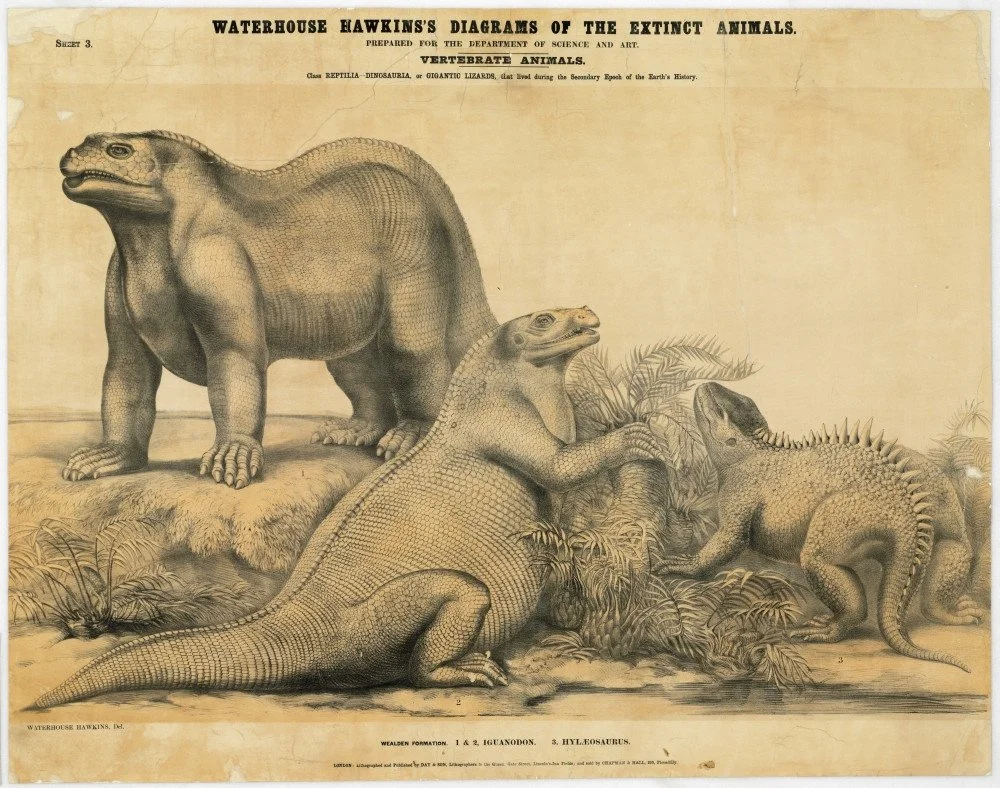
Crystal Palace Geological Park 1854 - two Iguanodons and a Hylaeosaurus
Dinosaurs are once more big business. The Jurassic Park franchise is going strong, the pioneering BBC series Walking with Dinosaurs has been joined by Apple TV’s Prehistoric Planet, Netflix’s The Dinosaurs and new immersive experiences are popping up regularly in London.
London, after all is where it all formally started, when in 1842 Sir Richard Owen - future founder of the now named Natural History Museum, created a new ‘sub-order of Saurian Reptiles’ named Dinosauria - terrible reptiles. This was based on observations he made on shared anatomical features that distinguished the Megalosaurus, Iguanodon and Hyleaosaurus from other land reptiles, ancient and extant. Life size concrete sculptures of these three species can be found in the Crystal Palace Geological Park, which is currently being refurbished. Try comparing the park's Iguanodon, with the Bernissart specimen in the NHM and with an up to date interpretation.
For anyone interested in guiding the NHM or any other collection of ancient life, I would like to share how palaeontologist are able to bring these creatures to life and the various fields of the sciences that underpin their interpretations. There’s a lot to unpack, but any given species may hold a great story about its discovery, anatomy, behaviour, environment where it lived in and its place on the evolutionary tree of life.
Until the 1980s dinosaurs were classified like all living organisms using the Linnaean classification system, which allocates species by hierarchies (kingdom, class, order, genus, species) and names them with a binomial system specifying genus and species, i.e. Tyrannosaurus rex (taxonomy). The former has been enhanced and latter is still in use, but organisms are now studied according to their evolutionary relationships to a common ancestor. In practical terms this uses cladograms to graphically show said relationships. The visual clade attached shows how archosaurs from the Triassic Period are ancestral to crocodiles, pterosaurs, dinosaurs and birds (phylogenetic systematics). The three main groups of dinosaurs which are easily recognisable are the Theropods (T-Rex, Velociraptors, birds - mostly carnivors), Ornithischians (Triceratops, Stegosaurs - many armoured) and Sauropods (Diplodocus, Argentinosaurus - massive, with long necks and tails).
The dating of any given species requires some basic understanding of geological time. Dinosaurs lived in the Mesozoic Era, which is divided into the Triassic, Jurassic and Cretaceous periods. Dinosaurs emerged in the Late Triassic, becoming dominant in the Jurassic, spanning about 165 million years, until the extinction of non-avian dinosaurs 66 million years ago. A Stegosaurs which lived in the Late Jurassic would have never met a T-Rex which lived at the very end of the Cretaceous.
Dinosaur fossils are the product of mineralisation of bone tissue over a long period of time. After death the specimen would have been quickly buried by sediments. The bone tissue would have then been infiltrated by water and minerals by chemical process (taphonomy). Sedimentary rocks are not datable, but igneous rocks in adjoining rock layers can be dated with radiometric techniques in which the constant rate of radioactive decay in argon, potassium and uranium can be measured (geochronology, stratigraphy). The NHM has a rich collection of original fossils, such as Sue the stegosaurus, and casts like Dippy the Diplodocus. Radio carbon dating can only be applied to wood, bone, or shells up to 60,000 years roughly, so no use for dino bones.
Bones and teeth are more likely to fossilised, but other structures have been found including skin, scale, feather impressions, filament structures, stomach contents, crests, hooves in duckbill hadrosaurs and very recently melanosomes (packets of pigments indicating colouration). The NHM’s treasured Archeoropterix lithographica is now believed to have had matte black feather tips and the Scolosaurus’s armoured back, shows scale patterns and spikes.
Fundamental to how species evolved their traits is their geographical distribution (biogeography). The supercontinent Pangea started breaking up in the Triassic, splitting into two land masses - Laurasia (North America, Greenland, Europe and Asia) and Gondwana (South America, Africa, Antarctica, India and Australasia). Today’s continents may show similarities in their fauna and flora, pointing to evolutionary ancestry, but also great diversity, the product of isolation and adaptation to local environments, i.e. marsupial mammals in Australasia vs placental ones everywhere else (there are exceptions). The evolution and distribution of dinosaurs is closely linked to these plate tectonic movements. Palaeontology and geology are joined at the hip.
In regards to behaviour, there are many deductive methods for hypothesising how any species behaved. Its morphology, anatomy and dentition may indicate feeding habits, diet, locomotive speed, sexual display and competition. Furthermore a host of advanced technical applications, such as CT scanning and computer modelling, are at hand to calculate body mass, bite strength, how strong were their senses for smell, sight and else (paleobiology). Notice the depressions in a T-Rex skull, where powerful muscles attached to drive its bone crushing jaw. A bit of T-Rex fossilised poop or coprolites, will not just buy you a holiday, but also alert you to the animal’s last meal. We can thank Mary Anning for first finding coprolites and Westminster Abbey’s Dean William Buckland for naming them. Other trace fossils include tracks, foot prints and eggs (ichnology).
Lastly, it is now common knowledge dinosaurs did not all disappear with the K-Pg mass extinction 66 million years ago. A branch of theropods classed as Avialae, made it through and went on to speciate and radiate into today’s over 10,000 species of birds. In China thousands of bird dinosaurs have being found over the last 30 years, but it was T.H. Huxley in the 1860s who proposed the link between the two, after comparing the Archeoropterix to the small theropod Compsognathus. If you want to understand more about dinosaurs, study birds!
In the next article I will describe the museum’s newest dinosaur on display using the above methodology.

Cladogram showing extinct and extant families descended from Archosauromorphea