How to read an Iguanodon
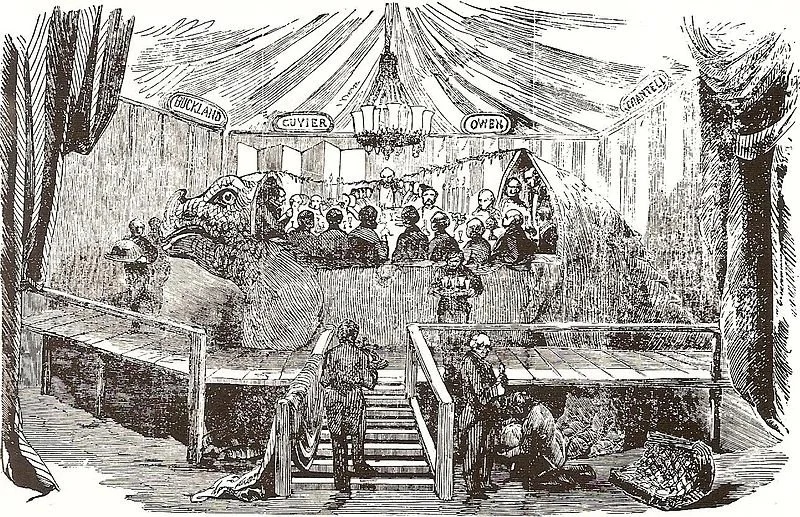
Richard Owen’s New Year’s bash, inside the Iguanodon cast
In the previous article I concluded with a series of questions about how to read a dinosaur using various scientific fields that inform palaeontologists’ interpretations. Let’s apply them to Iguanodon bernissartensis, which can be found at the NHM in London and the Oxford Museum of Natural History.
This specimen is mounted in a bipedal position, with its long tail on the ground and neck propped up in a kangaroo-like stance. It is roughly 16 feet high and approx. 25 feet from the tip of its snout to the end of its tail. It has long arms projecting forward with hands facing each other, as if carrying a laundry basket. Each hand has 5 large fingers with a weapon-like spiky thumb. When alive it would have weighed short of 9,000 lbs.
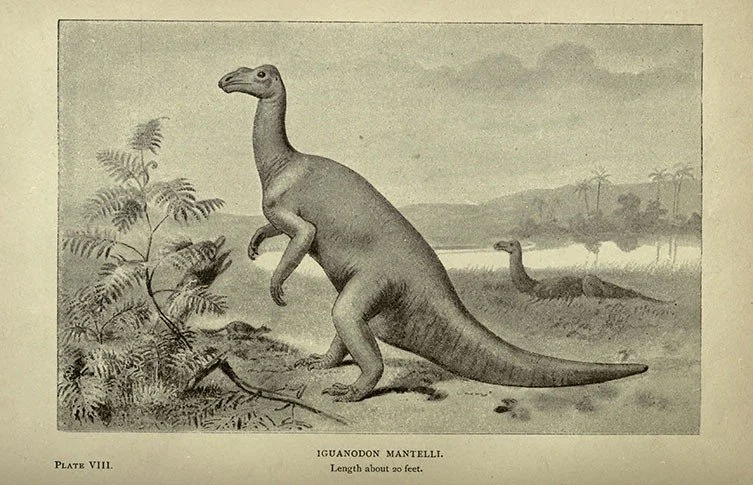
An obsolete depiction of an Iguanodon
Iguanodontids belong to the Ornithischians clade, so on the evolutionary tree they would have been more closely related to Triceratops than T-rex (theropod clade). They were herbivores and would have lived in large social groups in the tropical environment that was then Europe, in lush forests, coastal swamps, feeding on low-growing vegetation like ferns, horsetails and conifers.
Arguably, the Iguanodon is not the most charismatic of dinosaurs, but its discovery and subsequent evolving interpretation is a fascinating journey in the development of palaeontology.
As mentioned in part one, the Iguanodon was one of the three original species used by Sir Richard Owen in 1842 to create a new clade of reptiles termed Dinosauria. In 1822, pioneering palaeontologist Gideon Mantell and his wife discovered in a dump pit in Cuckfield Sussex, a set of teeth that looked like those of an iguana, albeit much larger. In 1834 Mantell got hold of the Maidstone slab, known as the Mantell-piece (Dinosaur Gallery, NHM). It shows some disarticulated bones including fragments of the skull, pelvis, feet, limbs, vertebrae and ribs. To the untrained eye, it’s hard to visualise what this creature looked like, but by then, Mantell’s descriptions and depictions showed a bulky iguana-like quadrupedal reptile covered in scales. Maidstone Borough Council features a green rampant Iguanodon in their coat of arms, how awesome!
Years later with the creation of the Crystal Palace Geological Park, it was Owen who acted as a consultant behind Benjamin Hawkins Waterhouse’s concrete sculptures of ancient beasts. Inevitably it was Mantell’s interpretation, which Hawkins followed, placing the spiky thumb on the creature’s snout, like a modern day rhinoceros. At the NHM, a model of the sculpture can be seen alongside a model of the Megalosaurus. The Crystal Palace sculptures are much derided nowadays for their inaccuracy, but back in 1854 they were the very first ever life size tridimensional depictions of ancient creatures. Their depictions were informed by pioneering palaeontologists with very limited fossil material, which forced them to rely on comparative anatomy to fill the gaps. It was also a novel entrepreneurial venture aimed at creating an educational leisure park, which included an enhanced Crystal Palace structure, with galleries reimagining ancient Greece and Egypt and an events venue. Isambard Kingdom Brunel worked on the lake’s impressive set of fountains, which operated in tandem with a tidal water system surrounding the sculptures, hiding and revealing at low tide Mary Anning’s Ichthyosaurus. Nearby a pair of Iguanodons, a Hylaeosaurus and a Megalosaurus bask in the sun.
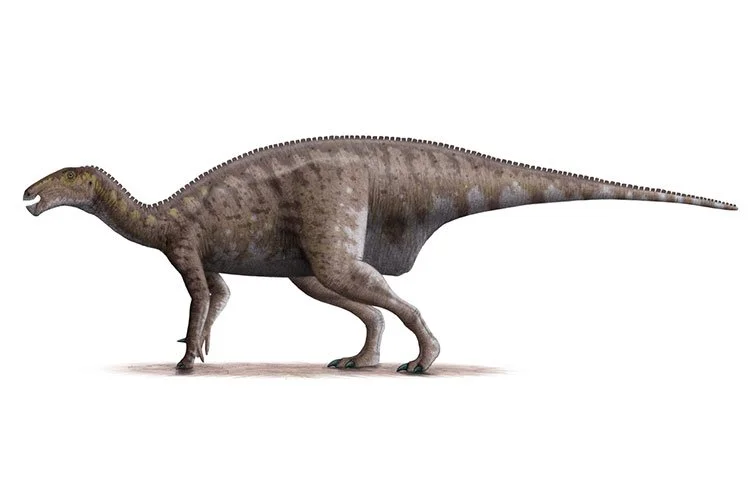
Mantellisaurus atherfieldens
Owen’s more crucial contribution to the project, was a dinner he organised on New Year’s Eve 1853 which took place inside the incomplete Iguanodon sculpture in Hawkins’ workshop. The event was reported in the London News, with a charming illustration of many gentlemen seated inside the beast under the names of Buckland, Cuvier, Owen and Mantell, the four leading palaeontologists of the age.
In 1878, 38 mostly fully articulated Iguanodon skeletons where discovered in a mine in Bernissart in Belgium, a combination of adults and young - it seems parents took care of their offspring. Our two casts are exact copies of the original mounted specimen still on display in Belgium. This Iguanodon interpretation is now obsolete. For a long time there was a perception, that the Iguanodon and other dinosaurs, including T-rex dragged their tails, suggesting they were slow moving and lethargic. No track fossils suggesting this has ever been found in rock formations with dinosaur fossils.
Both theropods and ornithischians are believed to have been warm-blooded, in lieu of their very active life style. Today’s Iguanodon’s interpretation shows them as being bipedal but able to walk or run on all four, horizontally postured with their necks parallel to the ground and a counterbalancing tail in the air, held in place by powerful muscles, (just like the Mantellisaurus atherfieldensis in the Hintze Hall - also an iguanodontid). A recent find in China of a Haolong dongi, a close relation, shows that some where covered with polygonal scales interspersed by spiky filaments.
The Iguanodon may not be as glamorous as a T-rex, but can still tell a good story that keeps being revised.
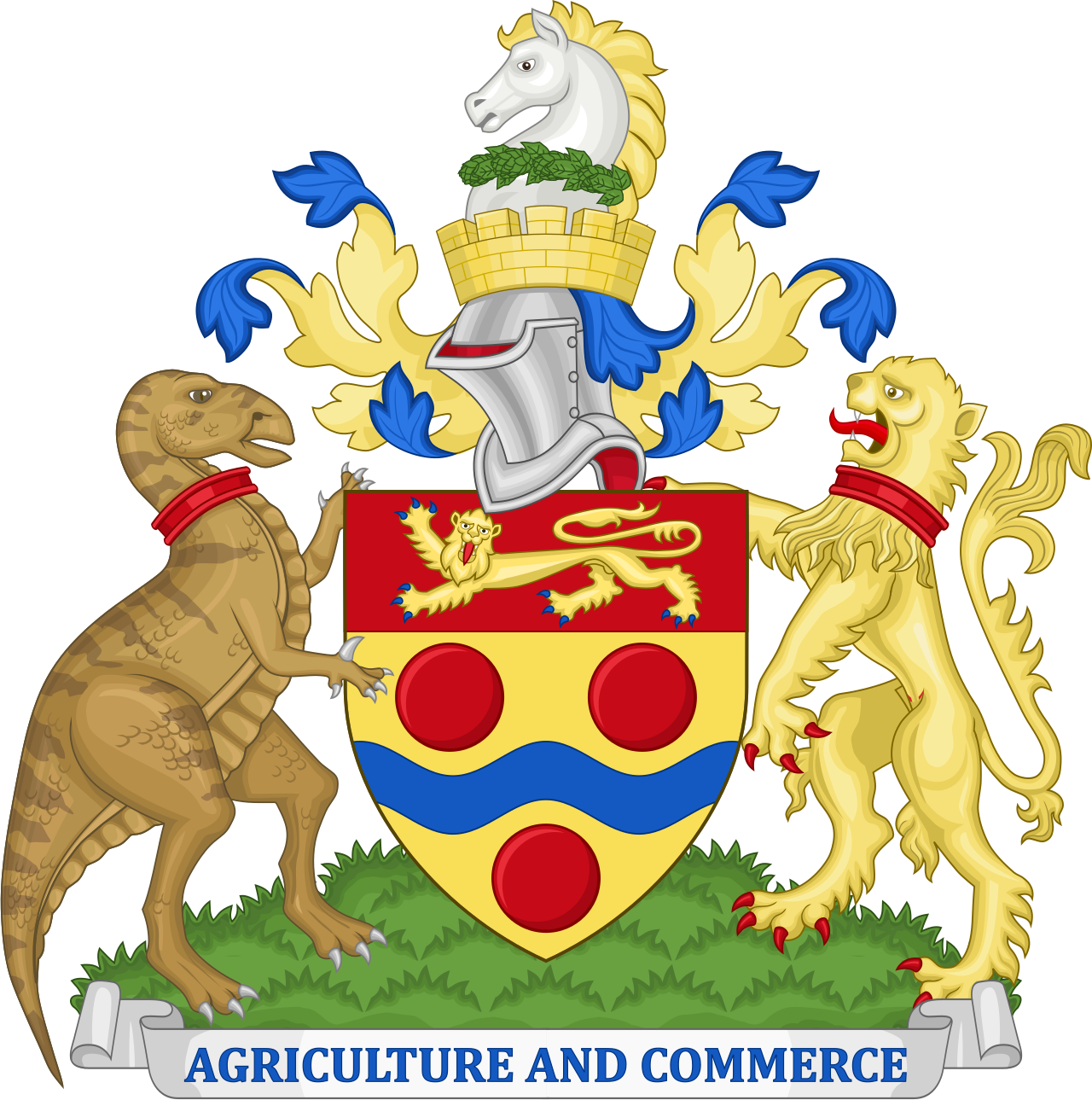
Maidstone Borough Council coat of arms